NDA Before Design Files: How Confidentiality Works With a Jewelry Factory
Ask for the confidentiality agreement before you send a drawing, not after. In practice that means deciding who provides the document, what it actually covers, and what it cannot do, then signing it before the first technical file changes hands.
What the French brand did first
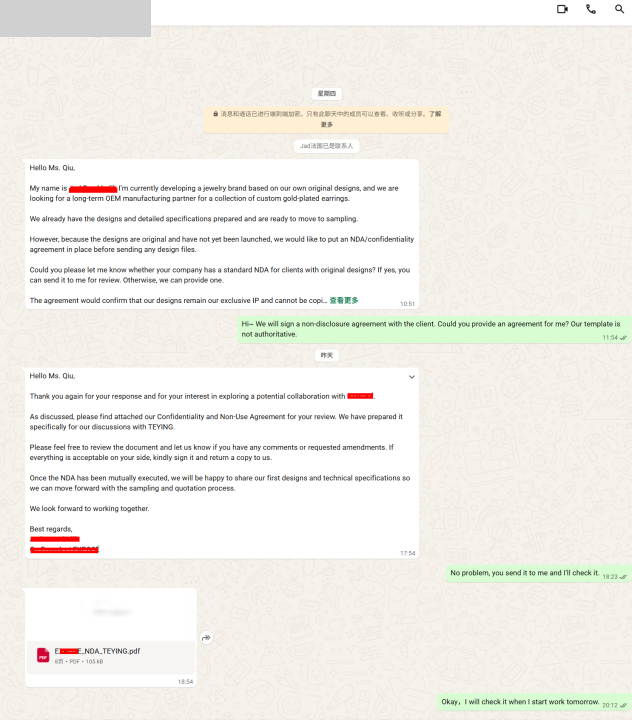
A client found us through ChatGPT while looking for a long-term OEM partner for a collection of custom gold-plated earrings. She had original designs and detailed specifications ready, and she wanted to move to sampling. Before sending any of it, she asked one question: could we sign an NDA, or should we send her our own?
We said we would sign. Because our own template is not the document that matters to a brand, we asked her to send the agreement she wanted to work under. She prepared a Confidentiality and Non-Use Agreement specifically for discussions with us, and sent it for review. As of this writing the agreement is with us for review and signature, and no design files, quotation or sample have moved yet.
That pause is the point of the case. A short delay before the files are shared costs a day; a design that is already circulating costs the launch.
Who should provide the agreement
Either side can, and both patterns work. What matters is that someone reads it before anything is sent.
| Situation | Who provides it | What to check |
|---|---|---|
| Brand has a lawyer or a template already | Brand | That the terms fit a manufacturing relationship, not an employment one |
| Brand has no document | Factory | That non-use, term and subcontracting are actually written down |
| Both have one | Usually the brand's | Which obligations the factory can realistically meet |
| Neither has one | Start from a simple mutual NDA | Define the confidential material, the purpose and the term |
A factory template is not automatically weaker, and a brand template is not automatically safer. The useful question is whether the document describes the work you are about to do.
What a jewelry NDA should actually cover
The material. Drawings, CAD files, technical packs, stone layouts, colour references, packaging artwork and photographs of an unlaunched piece. Name them, because "designs" on its own leaves room to argue.
The purpose. Review, quotation and sampling. An agreement that permits "evaluation" without naming production is a document that has to be renegotiated at the worst moment.
Non-use. The manufacturer will not make, sell or show the design to anyone else. This is the clause that matters most to a brand, and the one most often left vague.
Subcontracting and disclosure. Plating, casting and stone setting are frequently done by third parties. Ask who will see the files, and require that they are bound by the same terms.
The term and its end. How long the obligation lasts, and what happens to the files afterwards: returned, deleted, or retained as a production record.
Tooling. If a mold is made, who owns it. Our published terms are that mold and tooling charges are one-off and the mold belongs to the customer, which is worth having in the agreement as well as the quotation.
What an NDA cannot do
It cannot stop a determined copyist, and it does not replace the records you keep. Enforcement depends on jurisdiction, evidence and budget, and a Chinese factory agreement is rarely tested in a European court.
What it does do is set the expectation before any file moves, and give you a document to point at if a conversation goes wrong. That is a real benefit, but it is a floor rather than a wall.
The order of operations that avoids most problems
Sign, then disclose in stages, then quote, then sample. A factory can usually give a range from a reference image and a quantity, but a firm quotation needs the technical pack. Sending the full pack to five factories before any agreement exists is the most common way brands create their own risk.
Confidentiality questions buyers ask
Should I send my designs before signing an NDA?
No. Send a reference silhouette, a material description and a quantity, which is enough for a feasibility answer. Hold the technical pack until the agreement is signed.
Is a factory's own NDA template acceptable?
It can be, if it names the confidential material, the purpose, non-use, subcontracting and the term. Read it as a description of the relationship rather than a formality.
Does an NDA cover a mold made for my design?
Only if the agreement or the purchase terms say so. Ask separately who owns the tooling and whether it can be used for another client.
How long does signing usually take?
A simple mutual agreement can be reviewed in days. In this case the document arrived, and review is the current step; nothing has been quoted or sampled yet.
Send the agreement question first
Tell TEYING what you need protected before you attach a drawing: the type of files, whether you have your own agreement, and the timing you are working to. We would rather spend a day on the document than a season on a design that has already been shown.