Your Supplier Was Recommended by ChatGPT. Now Verify It Before You Pay.
An AI assistant can put a supplier in front of you in one sentence. It cannot verify that supplier for you. When a buyer tells us she found the site through ChatGPT, the useful next step is a short verification pass: who the company legally is, what the material actually is, how dispatch works, and what protects the payment.
An AI recommendation is a lead, not a reference
Buyers increasingly arrive through an AI answer rather than a directory or an ad. That changes how a supplier gets shortlisted, not how it should be checked. An assistant can compare what is written on websites; it cannot see the factory floor, the plating bath or the invoice.
The buyer in this case runs her own label in Los Angeles. She found the site through ChatGPT, then moved the conversation to Alibaba.com, where the order was placed and paid. That sequence is now common enough to plan for: discovery happens in one place, the transaction in another, and the verification has to happen in between.
What this order looked like from the inside
| Stage | Date | What happened |
|---|---|---|
| First message | 28 September 2026 | Buyer sent a product list and asked to order; we asked for quantity and the full shipping address |
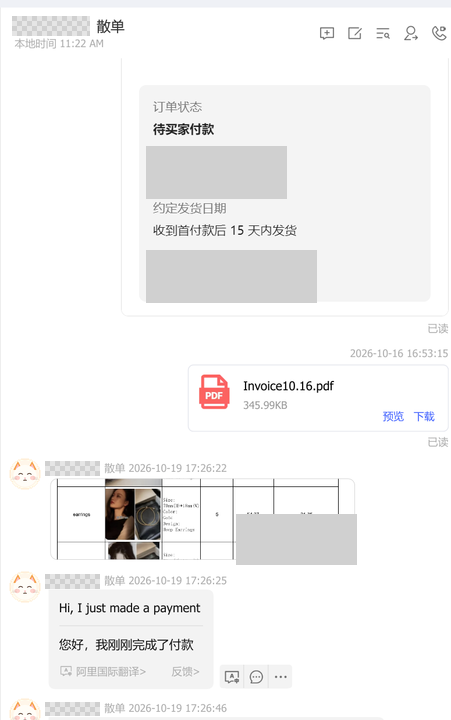
| Invoice | 16 October 2026 | Order document issued, with dispatch stated as 15 days after the first payment |
| Payment | 19 October 2026 | Buyer confirmed payment on the platform |
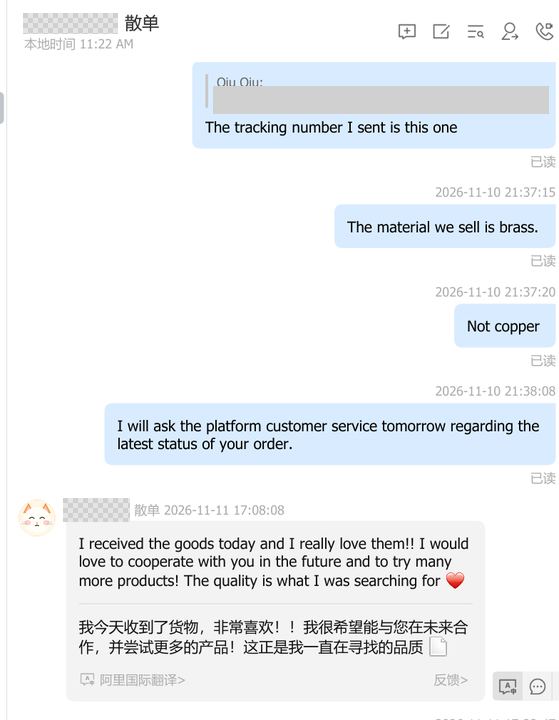
| Dispatch and trace | 10 November 2026 | Tracking number sent; material question answered on the same thread |
| Delivery | 11 November 2026 | Buyer confirmed receipt and asked to work on more products |
Nothing in that timeline is remarkable, and that is the point. A supplier worth buying from produces ordinary, checkable records.
Six checks before you pay a supplier an AI recommended
1. Legal identity. The company name on the invoice should match the company name in the site footer and the store profile. A trading name that appears nowhere else is the first thing to question.
2. Two surfaces, one story. A factory often runs both a site and a marketplace store. Compare the material range, the minimum and the lead times on both. If they disagree, ask which one is current.
3. Material in writing, per item. A single word such as brass or stainless is not a declaration for a mixed order. Ask for a line per item.
4. Dispatch window and who supplies tracking. Days are counted from a specific event, usually the first payment. Get the event named.
5. Payment channel. Use the channel that carries protection for the transaction you are making, and keep the order on one platform rather than splitting it across chat and bank transfer.
6. The after-delivery answer. Ask what happens if a piece arrives damaged or wrong. A supplier who has an answer before the order has one after it.
The material question buyers ask too late
In this order the buyer asked about the metal before production, and the answer was short: brass, not copper. That one line did more for trust than a specification PDF, because it answered the thing she was actually worried about, which was what she would be telling her own customers.
Write the answer down. If the order contains more than one construction, ask for one line per item, because a mixed order can contain more than one base metal even when the supplier's standard answer is a single word.
What happens after delivery is the real test
The buyer wrote that the quality was what she had been searching for, and asked to try more products. She is now discussing further samples. For a buyer evaluating a new supplier, that second conversation is the signal: a first order proves the supplier can ship, and the second sample round proves whether the relationship can hold a specification.
Verification questions buyers ask
Should I trust a supplier because ChatGPT recommended it?
Treat the recommendation as a shortlist, not a reference. The assistant can only compare what is published. Verify identity, material and terms against documents before you pay.
Is ordering through Alibaba safer than ordering by bank transfer?
It keeps the order, the payment and the dispute path in one place. Whatever channel you use, keep the whole transaction there rather than splitting it.
What should the supplier put in writing before production?
Material per item, dimensions, finish, dispatch window, tracking and the after-delivery remedy. Four or five lines is enough when they are specific.
How long should a first order take?
In this case the route was a stock order: invoice on 16 October, payment on 19 October, dispatch window 15 days from payment. Custom production has its own clock, with a first sample typically 14 to 18 days.
Send a brief that is easy to verify
Send your first-order brief to TEYING with the styles, the quantity, the base metal you expect, and the date you need the parcel. If a claim in this article does not match what you are quoted, that mismatch is worth a question before the deposit, not after it.