2.5 Microns and an XRF Report: The Vermeil Brief That Tells You the Buyer Is Serious
A serious vermeil brief reads like a specification, not a request. Base metal named, plating thickness numbered, restricted substances listed, and a document demanded to prove it. That is what arrived this week from a founder building a premium brand, and it is worth walking through line by line, because most first enquiries do not contain any of it.
How the conversation started
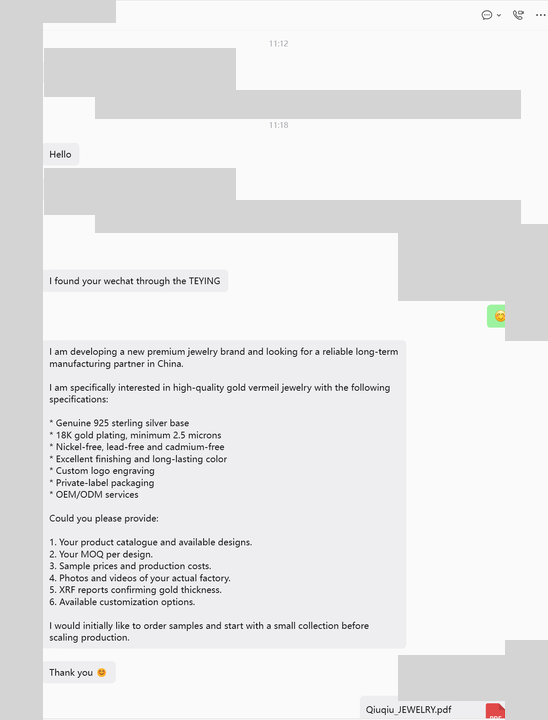
The founder is based in China and is building her own premium jewelry brand. She found TEYING through an AI assistant, followed the store link, and added us on WeChat to continue in Chinese. Her first message was not "how much" — it was a specification.
She asked for high-quality gold vermeil on a genuine 925 sterling silver base, 18K gold plating at a minimum of 2.5 microns, nickel-free, lead-free and cadmium-free, excellent finishing and long-lasting colour, custom logo engraving, private-label packaging, and OEM/ODM support. Then she listed six things she wanted from us: a catalogue, MOQ per design, sample and production costs, factory photos and videos, XRF reports confirming gold thickness, and the available customisation options. She plans to order samples and start with a small collection before scaling.
Why 2.5 microns has to be engineered
Plating thickness is the single number that decides whether a vermeil piece still looks gold after a season, and it is the one number a factory has to build into the process rather than simply agree to. A thicker gold layer takes longer in the bath and needs tighter process control to stay even across edges and recesses, which is why it has to be planned per surface rather than assumed.
Two and a half microns is achievable on sterling silver, and it is a choice rather than a default. The honest reply names what can be achieved on that specific design, where it will be measured, and what the tolerance is. A factory that answers "yes, 2.5 microns" without asking about the design is answering a question it has not understood.
| What the buyer specified | Why it matters | What the factory must confirm |
|---|---|---|
| 925 silver base | Vermeil requires a precious base, not brass | Silver content and hallmarking position |
| 18K gold, min 2.5 microns | Decides wear life and finish durability | Achievable thickness per surface, and tolerance |
| Nickel, lead, cadmium free | EU/US market access | Material declaration and test route |
| Logo engraving | Brand identity on the piece | Method, depth, and where it survives polishing |
| Private-label packaging | Retail presentation | Artwork, materials, and packing method |
The six documents a serious buyer asks for
Her list is close to a procurement checklist, and each item answers a different question.
A catalogue and available designs shows the visual language the factory can execute. MOQ per design tells her whether a small launch is possible. Sample and production costs separate the two budgets that buyers usually merge by accident. Factory photos and videos are the cheapest substitute for a visit. XRF reports turn "gold plated" into a measurement. Customisation options define how much of her own design survives the process.
None of these are unusual requests. What is unusual is receiving all six in the first message, which is why this brief is worth publishing as an example.
What the factory side should say back
The reply that builds trust names what is achievable on the design before anything else. Which thickness is realistic on this geometry, which surfaces are hard to measure, what the sample fee covers and whether it is credited against production, and how long the sample takes.
For reference, our published sample fee is USD 50 to 150 per sample and is creditable against bulk, a first sample typically takes 14 to 18 days, and bulk runs two to three weeks after approval. Our production minimum is 60 pieces per style. Those numbers give a buyer something to plan against, which is more useful than an enthusiastic yes.
Why samples before scale is the right order
A small first collection tests three things at once: whether the finish matches the promise, whether the packaging arrives intact, and whether the factory's communication survives a real order. Scaling before any of those is answered is how a premium brand ends up explaining a return in its first month.
This enquiry is at the sample stage. Nothing has been quoted, sampled or ordered yet, and saying so is part of the record.
Questions buyers ask about vermeil specifications
Is 2.5 microns of gold plating realistic on silver?
It is achievable on many designs, but it depends on geometry, surface area and the finish required. Ask for the achievable thickness per surface and the measurement method before approving a sample.
What does an XRF report actually prove?
It measures the coating at the points tested. It proves the thickness at those points, not across the whole batch, so the report should state where and how many readings were taken.
Does vermeil require 925 silver?
In the widely used trade definition, yes: gold vermeil is a thick gold layer over sterling silver, not over brass. If the base is brass, the correct description is gold-plated brass.
What is a realistic first order?
Our production minimum is 60 pieces per style. A first collection of a few styles at that quantity is a normal way to test finish, packaging and delivery before scaling.
Send the specification, not the wish
Send TEYING your material specification with the base metal, plating thickness, restricted substances, engraving and packaging requirements, plus the quantity per style and the date you need samples. If a number in your brief is not achievable on your design, we will say so before the quotation rather than after the sample.