TEYING BUYER GUIDE · UPDATED OCTOBER 23, 2026
Six Jewelry Directions for 2026, and What Each Costs to Build
A direction only matters once it survives the cost sheet. Six 2026 directions, each with the metal, the sample plan and the cost line it moves.
A mood board is not a brief
Trend decks sell a feeling. A purchase order needs a metal, a quantity, a price band and a date the cartons leave. Most of the money lost on a "trend collection" is lost in that gap: a buyer commits to a look that photographs beautifully, then discovers the price point cannot survive the way the piece has to be made.
What follows comes from sample requests and bulk orders that cross our benches, plus platform feedback buyers pass back after a season. Read it as direction, not prophecy. A shape that sells hard on one channel can sit flat on another, so the only filter that matters is your own customer, your own margin, and what moved for you last quarter.
Weight before shape: chunky gold
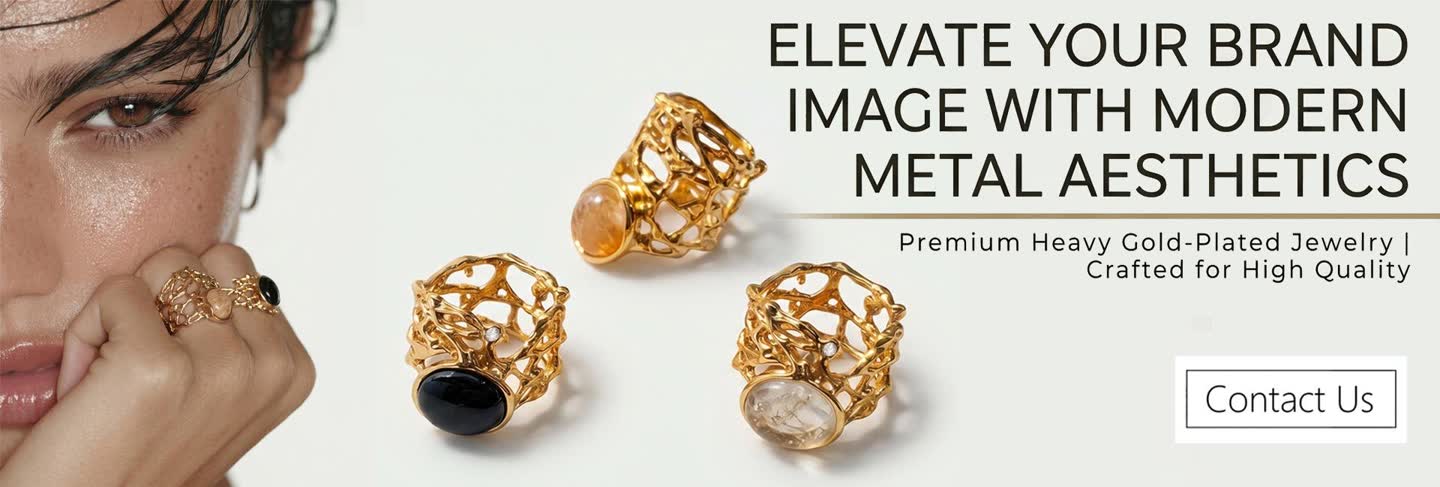
Oversized links, wide bands and heavy signets keep selling because they read as value on a phone screen. The decision underneath is weight and finish. A piece that feels substantial needs more metal per unit, which lifts unit cost faster than most buyers expect, and it needs plating coverage that survives harder contact. A chunky bracelet hits everything in reach.
For the brief, spec brass on the four-layer route and put thickness at the upper end for the pieces that get handled most. Bulk starts at 60 pieces per design, and 300-500 pieces is where plating and finishing settle into a repeatable band. Run a sample-only order first and wear the piece for a week. Weight on a wrist is not weight in a photo.
Personalization is an inventory decision
Engraved and birthstone-set units cannot go back into stock, and that single fact should shape the brief more than any trend report. Personalization converts well and creates a returns problem in the same breath.
Three practical points. Engraving needs setup, which lands in the tooling band of roughly $50-300 depending on method and depth. A birthstone option means carrying several stone colors, and CZ and semi-precious stones both work depending on the price band. And a personalized version usually launches better as a variant of a design that already sells, so unsold personalized stock stays small. First samples run 14-18 days typical, and a sample-only run is enough to test the idea before any bulk commitment.
Silver sold as a stack
Layered chains, mixed-width necklaces and stacking rings move as a look rather than as a single item, and that changes what you actually order. Decide how many SKUs create the look, and whether they ship together or as separates. 925 sterling silver with a rhodium finish keeps the white tone customers expect from silver and takes the friction of chains worn against each other better than a bare finish.
Put the whole stack into one sample round so lengths, link sizes and clasp drop can be judged together. If it ships as one SKU, the components have to be balanced within the same batch. If it ships as separates, every piece has to sell on its own.
Men's pieces live by the wear cycle
Men's chains, signets and cuff-style bracelets go to a customer who wears one piece every day and rarely takes it off. That habit drives the specification more than the styling does: more surface area, heavier clasps, contact points that meet keys, tools and gym equipment. Thickness and the protective top coat matter more here than on a delicate pendant.
Brass with gold plating covers the accessible band, 925 sterling silver covers the premium end, and a silver-tone rhodium finish handles the cooler look. Clasp strength and link articulation belong in writing before production. A chain that kinks or a clasp that slips kills a repeat order faster than a color mismatch ever will.
Pearl: the cheapest step upmarket
One pearl on a hoop, a pearl station on a chain, or a baroque shape worked into a charm makes a brand look more expensive without touching fine jewelry pricing. Freshwater pearl carries most of this work: available in volume that matches a 60-piece run, and varied enough that a collection reads as designed rather than bought in.
Quality is decided by matching inside a batch (size, luster, shape), how the pearl is secured, and whether the drill hole shows from the front. Ask for a matched lot and inspect the batch, not one perfect sample.
Sets and gift pairs: count the SKUs first
Necklace-and-earring pairs, bracelet stacks and gift sets built around one design story sell through gift channels and cut the decision effort for the shopper. Confirm how your supplier counts a set before pricing it. MOQ is quoted per design from 60 pieces, and a two-piece set is normally two production items, so the arithmetic is different from ordering a single SKU. Packaging does real work here: a logo card and a pouch that present the pair as one purchase.
What to settle before the sample leaves
| Direction | Material start | Decide now | Where the cost moves |
|---|---|---|---|
| Chunky gold | brass, four-layer route, upper thickness band | target weight, surface finish, contact points | metal per unit and plating time |
| Personalization | brass or 925 silver, CZ or semi-precious | engraving setup, stone colors held, variant or base design | setup fee plus unsellable stock |
| Silver layering | 925 sterling silver, rhodium finish | SKU count in the look, shared lengths | silver content and rhodium step |
| Men's pieces | brass with gold plating, 925 silver at the top | clasp strength, link articulation, thickness | heavier findings, longer plating |
| Pearl accents | brass or 925 silver base, freshwater pearl | matching grade, setting method, drilling | pearl lot sorting and labor |
| Matching sets | same as the components | one SKU or several, packaging tier | double the production items, one box |
Design and development work runs $200-800 per design and is credited against production orders over $2,000, so testing a new direction costs less than many buyers assume. The pattern that works is dull and reliable: sample the direction, put it in front of real customers, then decide on bulk once the sample has answered what a photograph cannot. A collection that ages well and one that dates in a season usually differ in one place, and it is not the trend. It is whether the piece was specified for how it will be worn.
If a direction is on your shortlist, send a reference image and target quantity through the quote form. We will come back with the material, plating, MOQ and sampling plan that fits, and say plainly when the price band and the quantity do not meet.
FAQ
Where do these directions come from?
Sample requests, bulk orders and platform feedback that buyers send back, not a forecast. They behave differently by channel, price band and audience, so use them as a starting point for your own brief and check each one against what already sells for your customer.
What is the cheapest direction to test first?
Chunky gold and silver layering, because both use standard materials and need no personalization setup. Brass or 925 silver, 60 pieces per design to start, with a sample-only run ahead of that. Personalization carries engraving setup and stone inventory, so it usually works better as a second step on a design that already sells.
How much does it cost to try a direction before committing?
First samples typically take 14-18 days and the sample fee runs $50-150, credited against production. Bulk follows 2-3 weeks after approval. Design and development at $200-800 per design is credited against production orders over $2,000, so a test run is rarely money thrown away.
Will any of these directions force a new material line?
No. Gold plated brass and 925 sterling silver remain the two core lines, with CZ, crystal, freshwater pearl and semi-precious stones as accents. Copper works as an electroplating base layer and zinc alloy appears in some casting processes. Trends move shape, proportion and finish, not the material menu.
How fast can a trend piece reach a selling season?
Faster than most buyers plan for, if the material is standard. A sample round at 14-18 days plus bulk at 2-3 weeks puts a decision made today in front of customers within roughly two months, assuming artwork and packaging are approved alongside the sample rather than after it.
Planning a 2026 collection?
Share your target customer, platform, and price band; the team can review which directions fit your brief.
Request a Factory Quote